
Media Art Scoping topics

E-volution of New Media

Wednesday, November 28th, 2001

Articles in Vol 21 no 3

The E-volution of New Media Art Full article available

Editorial by Kathy Cleland

An Ecology of OZ Mutant Media

Feature by Jean Poole
Wade Marynowsky, aka Spanky is a software engineer who has coded a new program which allows audio-video samples to be collated for the live performance of a particular ‘song’, triggered live through a preferably loud sound system and video projector. This innovation marks a step forward in the realm of audio-video intersection and hybridisation. The recent emergence of VJ’s (Vidi-yo Jockeys), artists who combine computer and VHS source materials to play with visual rhythms, create atmospheres, tell stories, respond to the music and provide visual stimulus also play a crucial role in this new media arena. Other new media collectives such as Shut up & Shop, Kraftwerk, the Distributed Audio Sequencer Environment crew and Labrat are here discussed. — More »

An End to Technophobia! Risk-Taking the way to go

Feature by Kim Machan
Machan turns the light on and examines the fears associated with technology – mystical secret language, complex software, indecipherable code – and furthermore those associated when art is involved. She proposes that the use of technology in everyday life be an experimental process, more aligned to the ways it is used in an art-based contexts. She states that: “through risk taking with fragile technologies we not only accelerate our knowledge but also accelerate relationships formed from the very human experience with technology”. — More »

Digital Drawing: The Same But Different

Feature by Mike Leggett
Drawing – the use of line and tone – is at the other end of a technology timeline currently unravelling in the digital age of information. The theory and practice of drawing ranges from a tool for honing perceptual disciplines to one that permits the free-flow of the obsessive-compulsive component of our personalities. Leggett looks at the works of artists Paul Thomas, Maria Miranda, Harriet Birks, Alyssa Rothwell, Mr Snow, Peter Callas, Simon Biggs and Damien Everett and the various digital tools they employ to assist in the documenting and ‘drawing out’ of their individual ideas. — More »

Do Art-droids Dream Of Electric Sheep? Full article available

Feature by Danny Butt
Peter Robinson and Jacqueline Fraser were the first two New Zealand artists ever to be included in the Venice Biennale. Both were chosen as a result of their work, rich in conceptual layering and with roots in Maori culture, but wrapped in appealingly conventional presentation styles with plenty of hooks for an international audience. This fact leads Butt to the discussion surrounding the support for New Zealand’s arts and culture sectors, pointing to a few examples such as Cuckoo, The Physics Room web project series and artists such as Sean Kerr and Warren Olds. — More »

Electrobricollage and Popular Culture

Feature by Darren Tofts
Tofts attempts to redefine that which is commonly known as ‘new media art’, as he believes it is out of touch with what’s actually going on in digital culture. He refers to a range of contemporary Australian artists utilising digital media to explore some of the ways old material is appropriated and remediated to present works that are new and unique. Amongst those are Josephine Starrs and Leon Cmielewski, Murray McKeich, Ian Haig, Nicholas Negroponte, David Carson, James Widdowson, Gregory Baldwin, Elena Popa, Greg O’Connor,Troy Innocent, Rebecca Young, Andrew Trevillian and Tina Gonsalvas. — More »

Inframedia Audio: Glitches and Tape Hiss

Feature by Mitchell Whitelaw
This article focuses on that which is known as ‘sound art’, ‘new media art’ or if a label is required the best might be simply ‘audio’. It is not so much a sound as a transparent substrate for organised expression but rather sound being mediated, synthesised, generated, collaged. Furthermore this article looks at the in-between sounds – the glitches, clicks, pops, and CD-skips – with many artists drawing on these entropic internal workings of audio processing systems. Artists include Nam June Paik, Minit, David Haines, Vicky Browne, Andrew Gadow and Netochka Nezvanova. — More »

Interfacing Art, Science and New Media

Feature by Anna Munster
Among the current metaphors used to describe the unfolding relations between art and science, the two ascriptions that have held sway most recently have been those of collaboration and/or intersection. Both art and science have sent out sets of feelers towards each other’s cultures which has in turn produced an overlapping sphere of cultural and intellectual activity. Following Lisa Jardine’s argument, Munster tentatively proposes that “we think through these connections as a process of hybridisation performed by the work of the technical-aesthetic objects themselves” rather than to declare a glorious new age of harmony, unity and productivity between the two. Artists Oron Catts, Ionat Zurr, Guy Ben-Ary, Justine Cooper, Michele Barker and Patricia Piccinini are in reference. — More »

Is Any Body Really There? Hybrid/Performance Arts Full article available

Feature by Keith Gallasch and Virginia Baxter
In a work that refuses language and conventional psychologising, Mary Moore’s production Exile, which opened at the Sydney Spring International Festival of New Music at The Studio, Sydney Opera House in 2000, the ascribed meaning is an experience rich in identification. This is pleasurably disorienting theatre that says it all about the ‘immersive’ experience from 3D to Cinemascope to TODD-AO to Cinema to VR. Other new media performance and installation works are brought into focus such as the Melbourne-based Company in Space work Trial by Video (1997), Liquid Gold by Lisa O’Neill, that of Queensland media artist Keith Armstrong and the Melbourne performance company The Men Who Knew Too Much. —More »

Out of Australia: International Exposure

Feature by Linda Wallace
This article poses the question of what new media art exhibitions, as international exports, can offer to us as a nation, as a ‘new media’ community and as individual artists, and of how they can function in terms of the transmission and propagation of certain ideas and images into what might be called ‘the world brain’. To discuss this Wallace looks at the structure and outcomes of PROBE, the first large-scale exhibition of contemporary, new media art ever held in Beijing which featured the work of Patricia Piccinini, Justine Cooper, Leon Cmielewski/Josephine Starrs, Brenda L. Croft, Zen Yipu and Jen Seevink, as well as including a range of internet sites. — More »

Polemic: An Allergic Reaction – The eminence grise in our Art Schools

Feature by Pat Hoffie
Artist/academic Pat Hoffie has been brooding on the rise and rise of the éminence grise in our teaching institutions and warns of the perils of giving in and being swept along by the current of the times. She is not the only commentator to observe that the visual arts created an irritating skin condition for itself in the eighties when, in search of institutional support, it mimicked the language of ‘professionalism’ and thus unwittingly exposed itself to the corrosive influence of bureaucracy. This is here discussed. — More »

Profile: Jon McCormack’s Evolving Ethics

Feature by Liminal Product
Most readers would probably have noticed that talk about A-life technology (or any technology for that matter) has a definite shelf life. Liminal Product [LP] quizzed internationally acclaimed computer artist Jon McCormack, whose paper [Re]Designing Nature given at dLux media art’s FutureScreen symposium on Artificial Life in October 2000, and recent piece, Eden exhibited at Cyber Cultures, Casula Powerhouse, in the same year, articulate many of the concerns about A-Life that Australian artists grapple with. — More »

Profile: Melinda Rackham’s Online Installations

Feature by Sean Cubitt
Time is the key. They say that the only law of physics that absolutely requires time is the second law of thermodynamics, the law that says systems tend towards entropy. That tendency is time’s arrow, the ineluctable winding down of the universe. Except, of course, for life. — More »

Sarai: New Media Initiative in Delhi

Feature by Samara Mitchell
In Delhi early in 2001, a new media research and development program Sarai: The New Media Initiative was launched carrying the energy and quality of intellectual exchange embedded within the history of the caravanserai, translated through the colourful codes, cants and images of public urban life within India’s cities. Sarai is a bold initiative facilitating formal and informal partnerships within India and internationally between the likes of hackers, philosophers, artists, media theorists, graphic designers, anthropologists, filmmakers and software developers. Some of the names which appear in this article include Meena Nanji, Rehan Ansari, Graham Harwood, Monica Narula, Sarah Neville, Mari Velonaki and Mukhul Kesevan. — More »

The A-gender of Cute Capital

Feature by Larissa Hjorth
One the one hand the notion of the ‘cute’ is seemingly universal and yet it is marked by specific cultural indices and contextual factors. The possible modes of employing the ‘cute’ is evidenced by the practices of Australian artists Martine Corompt and Kate Beynon. Both artists have a strong interest in character culture (ie. comics, cartoons) and their associated vernaculars; in turn they explore and outline different types of ‘cute’ landscapes. Both artists use ambiguity in the case of gender representation and utilise aspects of eastern and western contexts and character traits to create works which reinforce and subvert the constructions of gender, class and culture within the ‘universal’ graphic language. — More »

Update: Support for Australian Media Arts

Feature by Julianne Pierce
Through a process of active lobbying by various people around the country in the mid-eighties, the funding and institutional support for art and technology practice in Australia began to materialise. Some key figures in this push were Stephanie Britton, Louise Dauth and Gary Warner who saw the Australian Network for Art and Technology (ANAT) come into existence. The progress of the Australian new media arts scene is here documented from these early years and the various initiatives and supportive programs and events through to what is now the fundamental arts and cultural practice of the twentieth century. Artists Maria Miranda, Norie Neumark and Mari Velonaki are featured. — More »

Writing on the Net: Nodes and Hypertext

Feature by Linda Carroli
Many new media works contribute to the field of hypertext despite not being concerned with the literary. Corroli refers to Adrian Miles who likes to “think of hypertext as being primarily about links and nodes and their relations, which may or may not privilege words”. This topic is examined using examples where hypertext has become a primary focus such as the partnering of eWRe, trAce Online Writing Centre and ANAT who developed a series of online writing residencies in the late 1990s. Artists also discussed: Anne Walton, Francesca da Rimini, Sally Pryor, Diane Caney and Robin Petterd. — More »

The Souillac Conferences, 1997-1998

Friday, March 7th, 1997

In 1997, representatives of art and industry gathered in the French town of Souillac for a conference on the topic of “Art, Industry and Innovation.” The result from this meeting was “The Souillac Charter for Art and Industry: A Framework for Collaboration.” In 1998 a second conference built on the efforts of the first gathering, resulting in “Souillac II: A Conference on Art, Industry & Innovation: Final Report.” Both documents have been published separately in Leonardo On-Line and in Leonardo; the full, combined report is presented here in its entirety.


http://leoalmanac.org/resources/emonograph/souillac.html

CONFERENCE ON CYBERMIND

Friday, November 29th, 1996

CONFERENCE ON CYBERMIND: Registration, On-Line, and Program Information

FRIDAY-SUNDAY, NOVEMBER 29 - DECEMBER 1, PERTH AUSTRALIA

AT THE SCHOOL OF DESIGN, CURTIN UNIVERSITY OF TECHNOLOGY, BENTLEY CAMPUS

CYBERMIND96 is the first of its kind in Australia, with participation by
the Australian Aboriginal community, researchers, academics, artists and
students of cyberspace, living and loving on the net. 

The purpose of CYBERMIND96 is to discuss on-line environments, including
issues of technology, email lists, virtual reality, access, software,
philosophy, and psychology/psychoanalytics. Many of the presenters are
from the Cybermind email-list, which has been on-going for two and a half
years; some are also on FOP-L, and e-conf.

The conference has been designed for both real life and virtual partici-
pation (using low-end equipment if necessary). Online options will in-
clude the Cybermind MOO, two email lists, and CU-SeeMe projection. Vir-
tual participation is free of course.

To participate on-line in the conference:

Web site:
http://www.curtin.edu.au/conference/cybermind

Cybermind MOO
telnet://complex.curtin.edu.au:6666
134.7.170.170     port  6666

LOCAL ON-LINE FACILITIES

During the conference there will be a cybercafe in Perth for on-line dis-
cussion and exploration, with us, as part of your real life attendance
experience at CYBERMIND96.  In addition CUSeeMe will be available.

--------------------------------------------------------------------------

HOW TO REGISTER

Please document your details (name, insitution etc)
attach to payment, made out to Curtin University of Technology,
and forward to:

Cybermind96
TLG
Curtin University
GPO Box U1987
PERTH   WA   6001

or contact us 61 9 351 3872 (credit cards can be accommodated)
or at http://www.curtin.edu.au/conference/cybermind

Perth

Perth is the City of Lights, seen by John Glenn from space, on the Eastern
edge of the Indian Ocean.  Renowned for its lay-back, easy-style of living,
golden beaches and friendly people.

For further information, on accomodation, what to see and what to do,
please check
http://www.stour.net.au/Perth.html and read below.

--------------------------------------------------------------------------

Accommodation

Hotel            Royal Hotel - $40.00 per night single
                 Corner William & Wellington Sts, Perth
                  Ph (09) 324 1510
                  Fx (09) 321 2443

Backpackers       Britannia YHA Hostel - $21.00 p.night single
                  253 William St, Northbridge (Perth)
                  Ph (09) 328 6121
                  Fx (09) 227 9784

Student           Townsend Lodge - $15.00 p.night single
                         240 AdelaideTce  Perth
                         Ph (09) 325-4143
                         Fx (09) 421-1328

If you need assistance with accommodation please call
(09) 351 3872

Summer  season - BOOK SOON

   Before 22nd Nov                   After 22nd Nov
                                Waged   Unwaged         Waged   Unwaged

3 Day ticket            $130.00    $60.00          $150.00     $75.00  (Au$)

1 Day ticket            $50.00     $20.00          $55.00      $25.00  (Au$)

-------------------------------------------------------------------------

SPECIAL EVENTS

STELARC

http://www.merlin.com.au/stelarc/fracfles/fracfles.html

FRACTAL FLESH

Virtual Reality technology allows a transgression of boundaries between
male/female, human/machine, time/space. The self becomes situated beyond
the skin. This is not a disconnecting or a splitting, but an EXTRUDING OF
AWARENESS.  What it means to be human is no longer the state of being
immersed in genetic memory but rather in being reconfigured in the
electromagnetic field of the circuit -

IN THE REALM OF THE IMAGE.

Performance at PICA - 51 James St, Northbridge
4-7 pm
$5.00 at the door

Perth Institute Contemporary Art
Ph: 227 9339

RICHARD MACKINNON

'Building Virtual communitites'
As presented at Silicon Valley, Calif, USA
Details to be announced

Contact Details
Convenor:
Karen Melzack
melzack@iinet.net.au
Ph (09) 443 1004

CONFERENCE:

EMAIL Cybermind96@cc.curtin.edu.au
Fx: (09) 351 3938          Ph (09) 351 3872

OR CONTACT

Helen Roberts
Curtin University of Technology
GPO Box U1987
PERTH  WA  6001 Australia.
http://www.curtin.edu.au/conference/cybermind

-----------------------------------------------------------------------

PROGRAM: 

FRIDAY:
08.30 - 09.00   REGISTRATION

[08.45 - 09.00 MEETING OF PANEL CHAIRS - strategy meeting]

09.05 - 09.30   WELCOME - by Karen Melzack
                WELCOME - by Nyungah Community of Perth

09.30 - 10.00   MORNING TEA

10.00 - 10.30   KEYNOTE ADDRESS: Cybermind
                        - by Alan Sondheim

10.30 - 12.00   PANEL: Cybermind - The Virtual Community
                Chair: Richard MacKinnon
                Discussant: Lynne Roberts
                * Jon Marshall - The Lost Ethnographer (20 mins)
                * Jerry Everard - A  Semiotics of Cybermind (20 mins)
        Discussant - quick reminder of key points of each paper (15 mins)
                     then 35 mins question time

12.00 - 13.30   LUNCH

13.30 - 14.30   PANEL: Aboriginal Access to Cyberspace
                Chair: Karen Melzack
                * Anna Cole - Current Status of Indigenous Australians & the Net
                * Jill Abdullah - Postgrad Interactive Programs @ Curtin
                * Michelle Winmar - Reconstruction/ Family History/Cultural Trad
                * Ernie Stringer - Assessing and Supporting Research

14.30 - 15.00   AFTERNOON TEA

15.00 - 16.30   PANEL: Weaving Webs
                Chair: Lynne Roberts
                * Terry Maybury - Virtual Story Telling
                * Glenda Nalder - Virtual Images
                * George Borzyskowski - Hacker Demo Scene

[16.40 - 17.00 MEETING OF PANEL CHAIRS

*******************************************************

SATURDAY

 08.30 - 08.45 MEETING OF PANEL CHAIRS

09.00 - 10.30   PANEL: Cyber Spaces
                  Chair  Jerry Everard
                * Fanny  Jacobson - TBA
                * Melinda Wearne -  Structural Aesthetics
                * Geoff Rehn - Interactive Environment on PC
        20 mins each then Chair summary of key points + 20 mins questions

10.30 - 11.00   MORNING TEA

11.00 - 12.30   PANEL: Law and Ethics in Cyberspace
                Chair: Ari Mendoza
                * Rob Cover - Social Development, Social Reality & Internet
                * Suzanne McKenzie - Informed Consent in Virtual Reality
                * Richard MacKinnon - Governance in Cyberspace

12.30 - 13.30   LUNCH

13.30 - 15.00   PANEL: Philosophy in Cyberspace
                Chair: Richard MacKinnon
                * Ari Mendoza - The Cybermind Hand
                * Jerry Everard - Deleuze: The Subject of Cyberspace
                * Alan Sondheim - Love, Sex & Death in Kyberspace
                Chair's summary of key points (10 mins) then 20 mins questions

15.00 - 15.30   AFTERNOON TEA

15.30 - 16.30   FORUM: Cybermind: The Philosophy and Psychology of Cyberspace
                Chair: Karen Melzack
                Participants: Alan Sondheim, Richard MacKinnon, Jerry Everard,
                        Jon Marshall, Ari Mendoza

******************************************

SUNDAY

[08.45 - 09.00 Meeting of Panel Chairs]

09.00 - 10.00   PANEL: Education @ Web
                Chair: Martin Dougiamas
                * Eilean Fairholme - WWW Instructional Design
                * Michael Grau - TBA
                * Martin Dougiamas - Machine-Augmented Thought

10.00 - 10.45   WORKSHOP
                Leader: Alan Sondheim

10.45 - 11.00   MORNING TEA

11.00 - 12.30   PANEL: Self in Cyberspace
                Chair: Jerry Everard
                * Jon Marshall - Virtual Hauntings
                * Stelarc - Phantom Bodies
                * Lynne Roberts - Exploring Virtuality

12.30 - 13.30   LUNCH

13.30 - 15.30   PLENARY: Alan Sondheim - Person/Text
                          Chair Ari Mendoza
                           *Alan Sondheim
                           *Jon Marshall

15.30 - 16.00   AFTERNOON TEA

16.00 - 16.45   ROUND-TABLE: Cybermind - Whence and Whither?
                         Conference Outcomes
                          Chair: Ari Mendoza
                          Participants: Alan Sondheim, Jon Marshall, Ari
                          Mendoza,
                          Richard MacKinnon, Fanny Jacobson, Karen Melzack
                          and other
                          CMers

Peter Callas KINEMA NO YORU (FILM NIGHT): NIGHT’S HIGH NOON: AN ANTI-TERRAIN

Monday, July 4th, 1988

http://www.videoartchive.org.au/pcallas/kinema.html

http://www.videoartchive.org.au/pcallas/nights.html

Experimenta

Monday, June 30th, 1986

Since 1986, Experimenta has transformed public spaces, exhibition venues and corporate environments into captivating, interactive, and thought provoking destinations. From large-scale outdoor installations to intimate and extraordinary indoor exhibitions, the artworks shown worldwide by Experimenta are always evocative, intriguing and uniquely multi-sensory.

Experimenta is respected as Australia’s leading organisation dedicated to commissioning, exhibiting and promoting the most advanced media and technology-based art. In partnership with organisations that share our vision, we have nurtured some of the brightest rising stars in contemporary art.

http://www.experimenta.org/aboutus.html

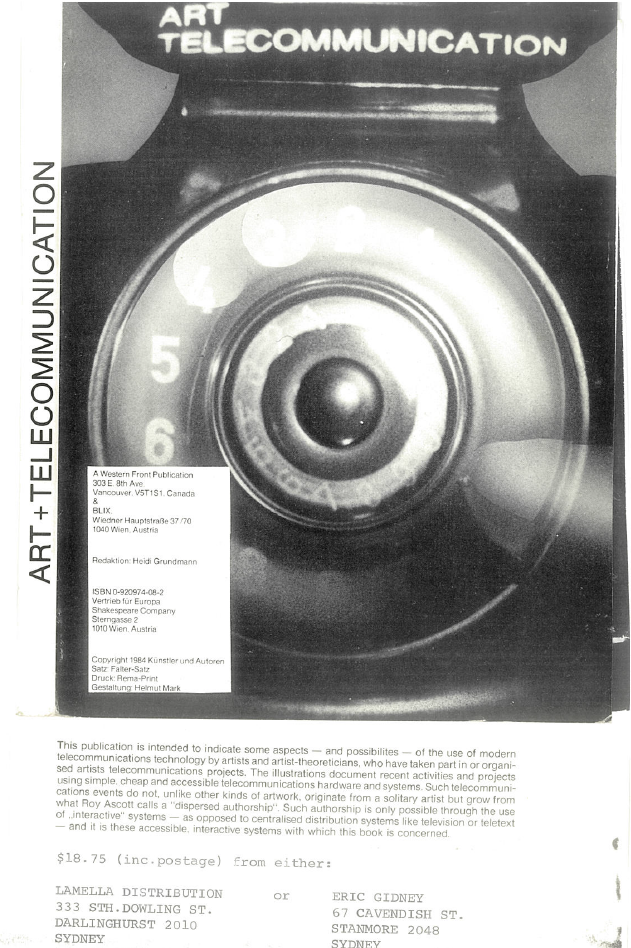
Art and Telecommunication

Saturday, May 12th, 1984

Art and Telecommunication poster


Interactive systems used by artists,

By Eric Gidney


Screen Shot 2015-05-12 at 1.17.21 pm

Art and Telecommunications poster


Digicon

Tuesday, August 16th, 1983

The first three way

canadian pharmacy no prescription

simultaneous performance by Satellite in history


CROSSING OVER: RAISING THE GHOSTS OF TASMAN-PACIFIC ART EXCHANGE: ANZART-IN-HOBART, 1983

Monday, May 30th, 1983

In 1983 ANZART-in-Hobart moored in Tasmania and although, this trans-Tasman vessel represented a major event, it was swamped by ambitious scale, lack of Australian arts funding towards professionalisation and curatorialism. 


http://www.nzetc.org/tm/scholarly/tei-Sch091JMS-t1-g1-t4.html

zp8497586rq

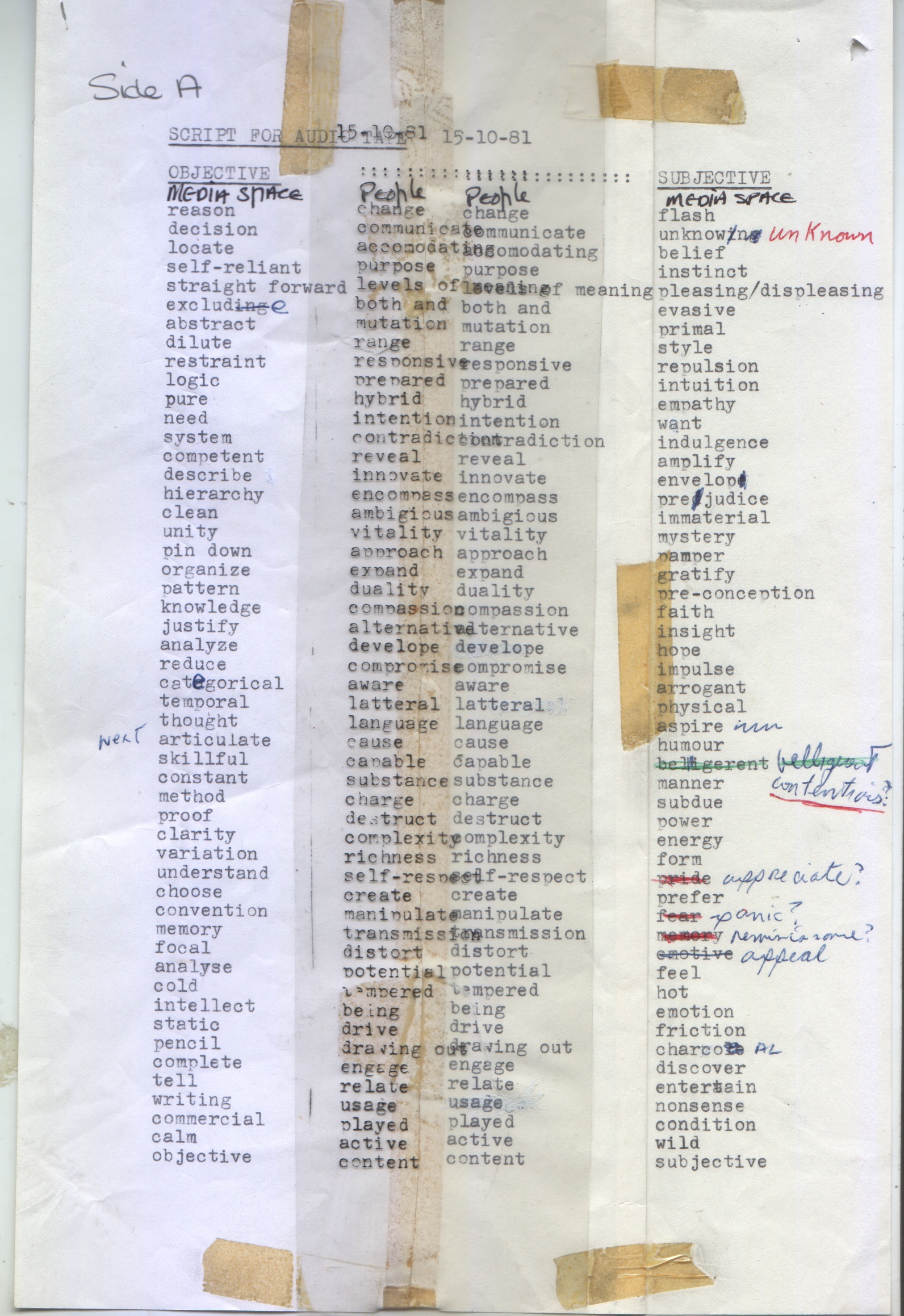
Objective Subjective

Friday, October 23rd, 1981

Media -Space

Script for the first audio work produced by Paul Thomas and Allan Vizents 1981.

zp8497586rq

Media Space meeting on the 8th May 1981

Friday, May 8th, 1981

Audio recording of Media Space meeting on the 8th May 1981 with Anne Graham, Judy Chambers, Brian Mckay, Julian Goddard, Jeff Jones, Paul Thomas, Alan Vizents.

MedaSpace_8-5-81