STELARC "Amplified Hands" Performance 1982
Friday, October 15th, 1982Documentation from Stelarc performing “Amplified Hands” at the City Art Institute, October 15, 1982.


Documentation from Stelarc performing “Amplified Hands” at the City Art Institute, October 15, 1982.
For the Ars Electronica Festival: A project connecting artists around the world via computer and telefax link.
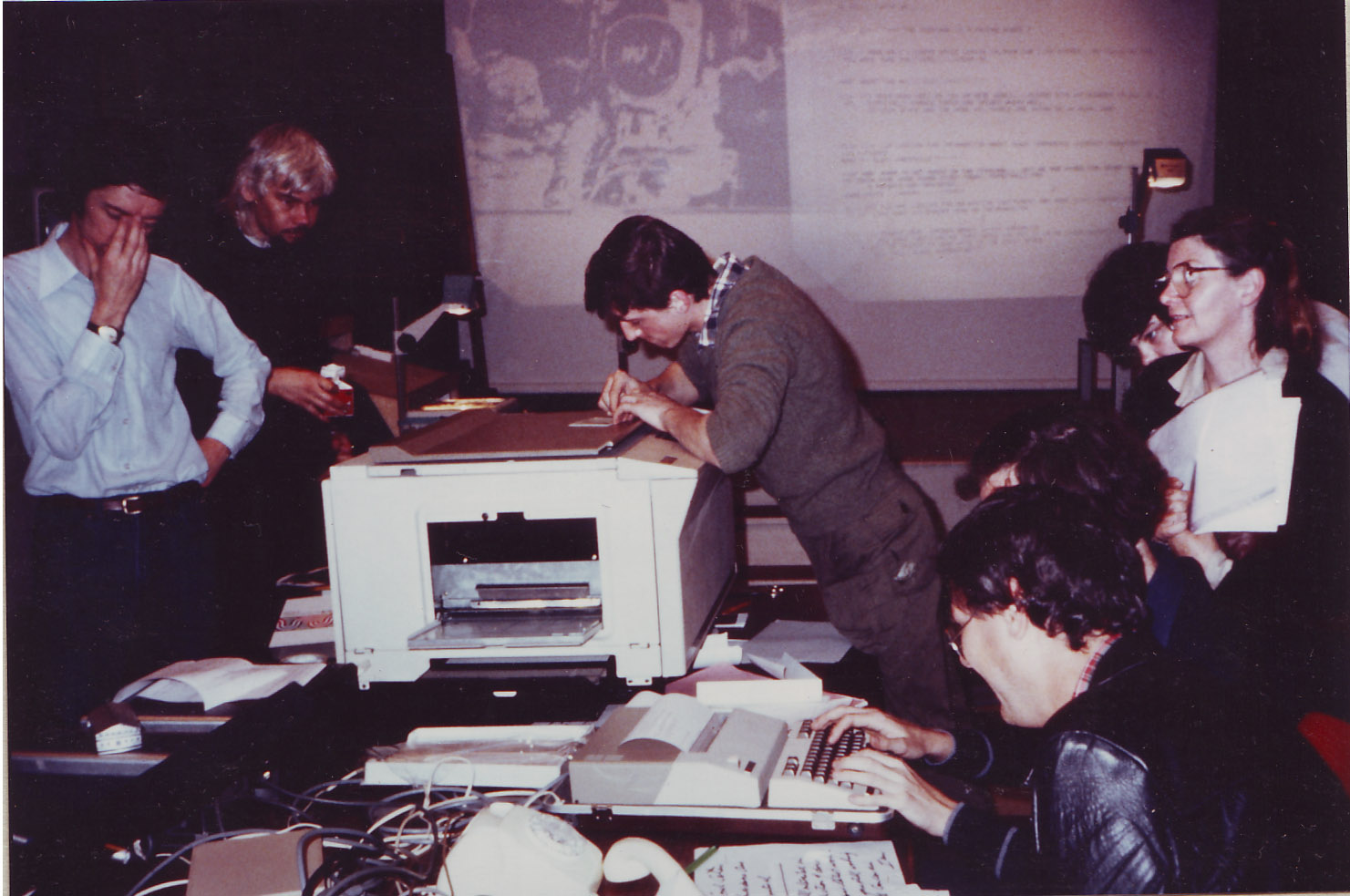
New Full copy of world in 24 hours
The world in 24 Hours catalogue
Robert Adrian X Artist’s Use of Telecommunications, Ars Electronica archive
The report of this committee was submitted to the Australia Council in April 1984.
The report analyses the effect on the arts of developments in technology.
Download ozcoreport.pdf
Flyer for the showing of Eric Gidney’s Telesky work @ Sky Art Confrence ’81
mass.nomad.net.au/wp-content/uploads/2009/05/skyartconference1981-copy.pdf“>skyartconference1981-copy
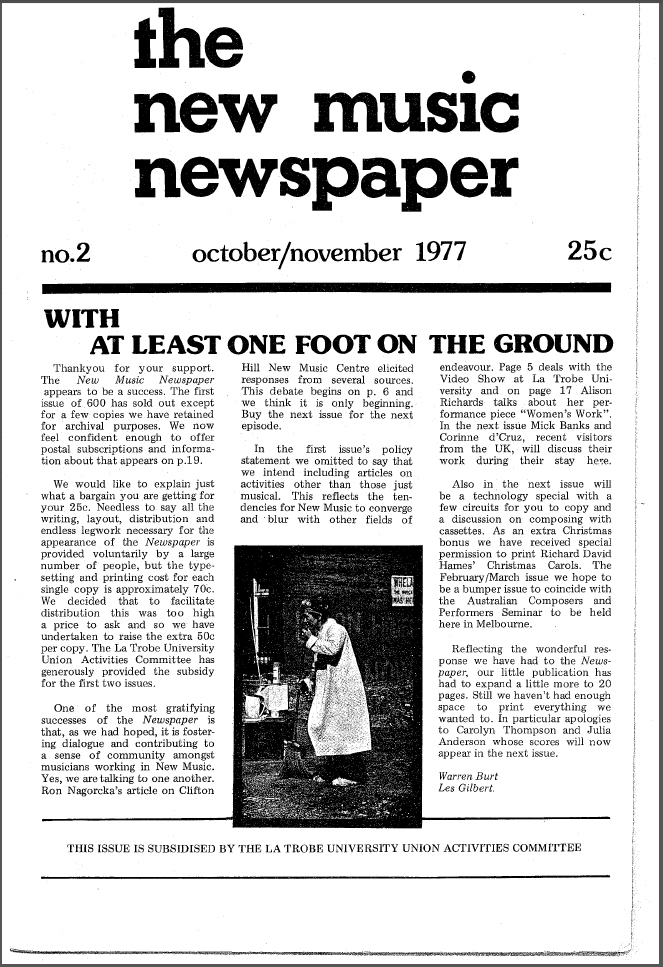
Pioneer of media art in Australia Warren Burt work
ed in academia (La Trobe University, NSW Conservatorium, Victorian College of the Arts, Australian National University), education, and radio (freelance and commissioned productions for ABC and PBAA), and as a composer, film maker, video artist, and community arts organizer.
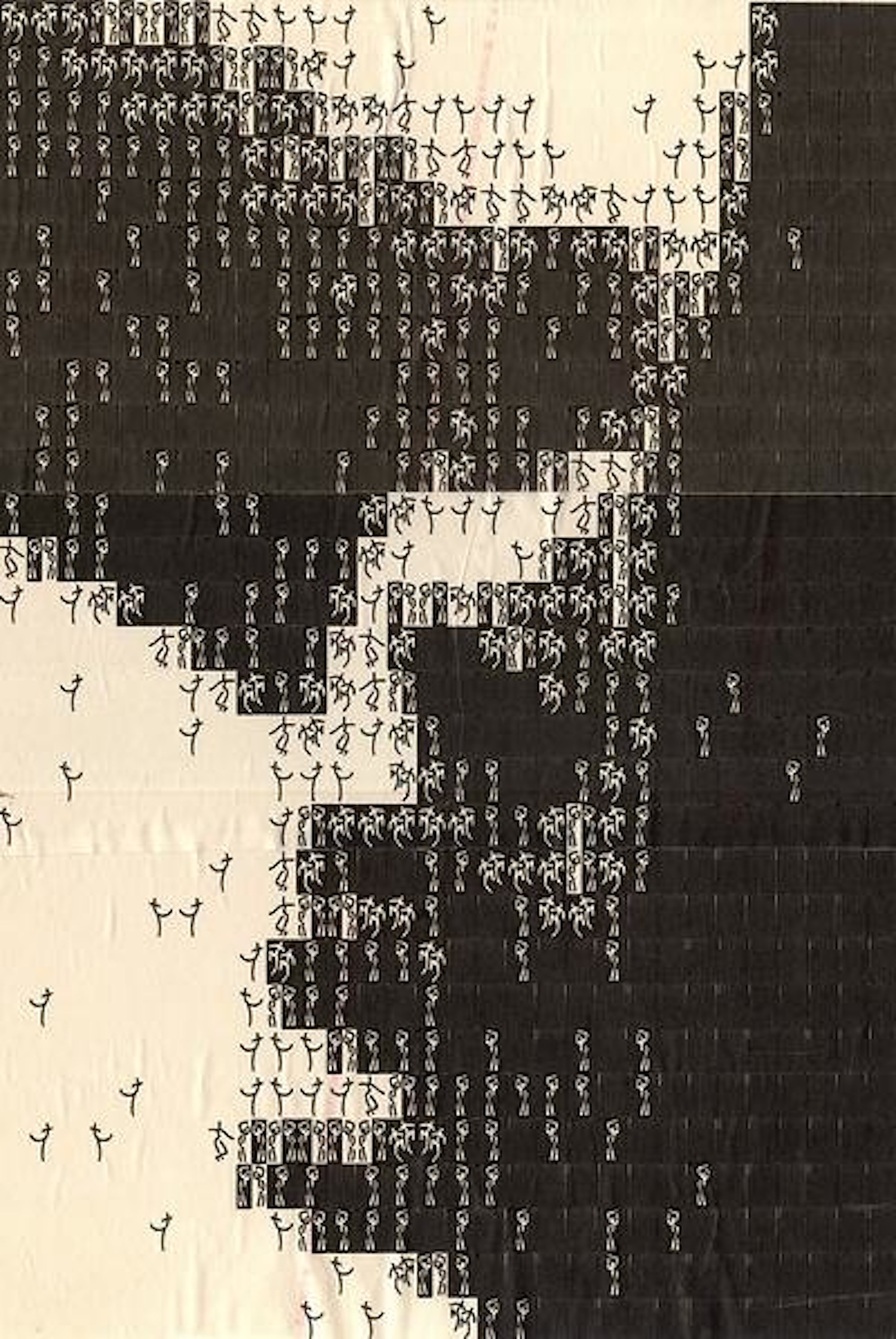
Australia 75 set out to provide an opportunity for the public to see the work of, and interact with, scientists and artists working in many fields. Science exhibits included astronomy and prehistory, communications technology and environmental monitoring, geology, botany and medical science. The arts were represented in exhibitions of craft such as ceramics and weaving; visual art, with paintings by Sidney Nolan and Arthur Boyd; sculpture and aboriginal art; and presentations of music and theatre and other aspects of the performing arts. For some, the computer arts exhibition would be the most exciting part of the festival.
In Australia this was a period of great optimism for the future; the Vietnam War was ending (30 April 1975, fall of Saigon) and colour television had just arrived (1 March 1975). Gough Whitlam was Prime Minister and it was a good time for the arts, a good time to go to university, and there was plenty of interest in science and technology. But that technology was still very difficult to access. Computers were large monsters hidden away in air conditioned floors of banks, insurance companies, government offices and universities, while science fiction writers dreamed up all sorts of scenarios in which computers would take over the world and turn us into slaves. For most people their only contact was through computer forms on punched cards and the phrase ‘Do Not Spindle, Fold or Mutilate’. Occasionally you could see a computer at a University Open Day, where you might have been fortunate enough to receive a computer print-out of a calendar with a picture of Snoopy at the top, but you would almost never get to use one for your own creative work.
The very first personal computers were just becoming available and came as a kit you had to build and program yourself. The only people who were likely to do that were electronic hobbyists and a few young scientists. One of those scientists was Doug Richardson, a young computer programmer at the University of Sydney, who had recently completed a computer graphics software project (using a system known as a PDP-8 – a mini-computer used in many scientific laboratories both in Australia and overseas). Some of the work he produced with other artists interested in experimenting with technology was shown in exhibitions in Sydney and Brisbane. This led to Anderson receiving an invitation to organise an exhibition of computer arts for the Australia 75 festival. He decided to call the exhibition Computers and Electronics in the A
rts and invited many of the people he had worked with, and their friends, to contribute.
For Anderson the exhibition would provide ‘the opportunity to present the computer in a more favourable light than that of monster’. He wanted people to see that the computer could be adapted to all artforms, and he used the exhibition to demonstrate this with work by artists, musicians and computer scientists ‘with an understanding
of the potential of machines’ and from whom ‘will come tomorrow’s accepted visual and aural self-expression by means of the computer’.
The exhibition predicted the ubiquity of computers for everyone and, by bringing together the country’s leading artist/technologists, demonstrated some of the possibilities that newly-developing technologies in computing, video and audio production, and interactive performance, would bring about. The exhibition also aimed to ease access to the new technologies and make them less threatening; making it possible for the audience to not only watch but also participate in their use.
The people who contributed to the exhibition by presenting their artworks and experimental technologies ranged from artists working with lasers, portable video technology, analogue music synthesisers and a prototype digital music computer, to composers working with computer programmed music for live musicians, engineering experimenters from the University of NSW and the Australian National University and dancers who made their own music using pressure-sensitive floors. They included:
Stan Ostoja-Kotkowski, who showed his responsive paintings (using Theremins) and Laser Chromasons, which responded to the viewer with displays of colour and sound.
Philippa Cullen and her dance company, who brought a set of pressure-sensitive floors that could control a sound synthesiser.
Greg Schiemer and Phil Connor, who brought their theremins and computer-based synthesiser.
Bush Video, who showed the many new approaches to video making they were engaged in.
John Hansen, who showed his video synthesiser and electronic jewellery.
Stephen Dunstan, who showed his hand-built audio synthesisers and brought musical joy to the whole event.
James Penberthy, an Australian composer who used a computer to compose music and display it to the musicians for performance as it was being written.
Harvey Holmes and Roger Covell showed their new sound synthesiser project known as the Timbron, constructed by students at the University of NSW.
ANU Department of Engineering Physics showed their computer video drawing system with very early versions of the drawing tablet and the frame buffer.
New Music Centre, Melbourne, brought their improvised and experimental music performances.
Computer Graphics and computer films by Doug Richardson and his colleagues, and by many others.